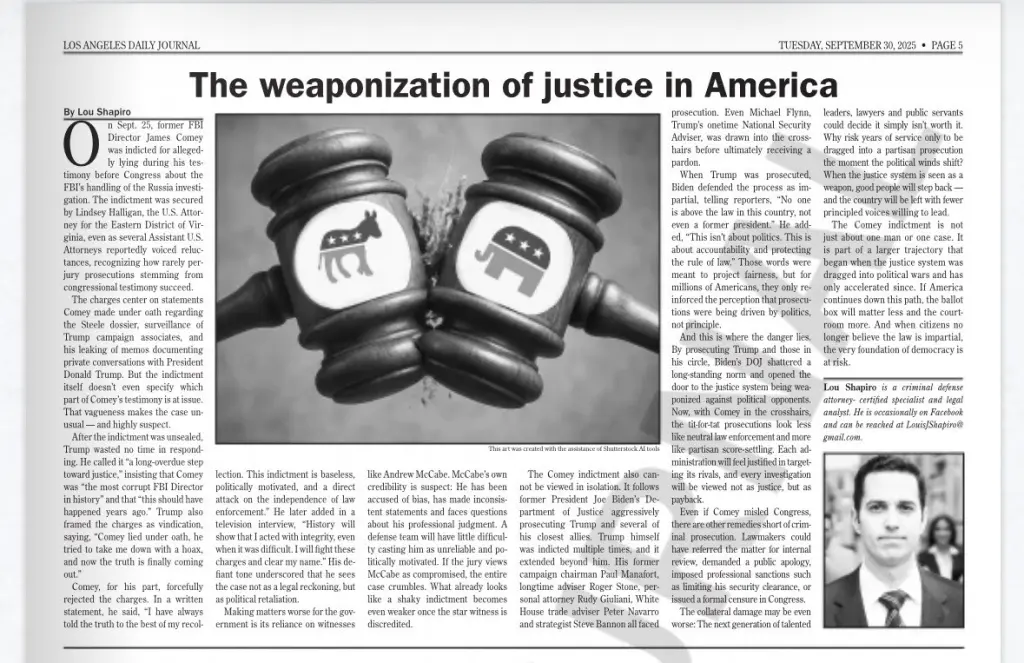
Lou Shapiro examines the September 25, 2025 indictment of former FBI Director James Comey on charges of lying to Congress, and places it in a longer pattern of politically charged prosecutions.
He argues that once prosecutions of political figures became routine, each new case began to look like score-settling rather than neutral law enforcement. Even if Comey misled Congress, he writes, remedies short of a criminal case were available, such as internal review or professional sanctions. He warns that when the justice system is seen as a weapon, principled people will step away from public service and the public will lose faith that the law is applied impartially.
Published in the Los Angeles Daily Journal, September 30, 2025.
Full text of the article
On Sept. 25, former FBI Director James Comey was indicted for allegedly lying during his testimony before Congress about the FBI’s handling of the Russia investigation. The indictment was secured by Lindsey Halligan, the U.S. Attorney for the Eastern District of Virginia, even as several Assistant U.S. Attorneys reportedly voiced reluctances, recognizing how rarely perjury prosecutions stemming from congressional testimony succeed.
The charges center on statements Comey made under oath regarding the Steele dossier, surveillance of Trump campaign associates, and his leaking of memos documenting private conversations with President Donald Trump. But the indictment itself doesn’t even specify which part of Comey’s testimony is at issue. That vagueness makes the case unusual — and highly suspect.
After the indictment was unsealed, Trump wasted no time in responding. He called it “a long-overdue step toward justice,” insisting that Comey was “the most corrupt FBI Director in history” and that “this should have happened years ago.” Trump also framed the charges as vindication, saying, “Comey lied under oath, he tried to take me down with a hoax, and now the truth is finally coming out.”
Comey, for his part, forcefully rejected the charges. In a written statement, he said, “I have always told the truth to the best of my recollection. This indictment is baseless, politically motivated, and a direct attack on the independence of law enforcement.” He later added in a television interview, “History will show that I acted with integrity, even when it was difficult. I will fight these charges and clear my name.” His defiant tone underscored that he sees the case not as a legal reckoning, but as political retaliation.
Making matters worse for the government is its reliance on witnesses like Andrew McCabe. McCabe’s own credibility is suspect: He has been accused of bias, has made inconsistent statements and faces questions about his professional judgment. A defense team will have little difficulty casting him as unreliable and politically motivated. If the jury views McCabe as compromised, the entire case crumbles. What already looks like a shaky indictment becomes even weaker once the star witness is discredited.
The Comey indictment also cannot be viewed in isolation. It follows former President Joe Biden’s Department of Justice aggressively prosecuting Trump and several of his closest allies. Trump himself was indicted multiple times, and it extended beyond him. His former campaign chairman Paul Manafort, longtime adviser Roger Stone, personal attorney Rudy Giuliani, White House trade adviser Peter Navarro and strategist Steve Bannon all faced prosecution. Even Michael Flynn, Trump’s onetime National Security Adviser, was drawn into the crosshairs before ultimately receiving a pardon.
When Trump was prosecuted, Biden defended the process as impartial, telling reporters, “No one is above the law in this country, not even a former president.” He added, “This isn’t about politics. This is about accountability and protecting the rule of law.” Those words were meant to project fairness, but for millions of Americans, they only reinforced the perception that prosecutions were being driven by politics, not principle.
And this is where the danger lies. By prosecuting Trump and those in his circle, Biden’s DOJ shattered a long-standing norm and opened the door to the justice system being weaponized against political opponents. Now, with Comey in the crosshairs, the tit-for-tat prosecutions look less like neutral law enforcement and more like partisan score-settling. Each administration will feel justified in targeting its rivals, and every investigation will be viewed not as justice, but as payback.
Even if Comey misled Congress, there are other remedies short of criminal prosecution. Lawmakers could have referred the matter for internal review, demanded a public apology, imposed professional sanctions such as limiting his security clearance, or issued a formal censure in Congress.
The collateral damage may be even worse: The next generation of talented leaders, lawyers and public servants could decide it simply isn’t worth it. Why risk years of service only to be dragged into a partisan prosecution the moment the political winds shift? When the justice system is seen as a weapon, good people will step back and the country will be left with fewer principled voices willing to lead.
The Comey indictment is not just about one man or one case. It is part of a larger trajectory that began when the justice system was dragged into political wars and has only accelerated since. If America continues down this path, the ballot box will matter less and the courtroom more. And when citizens no longer believe the law is impartial, the very foundation of democracy is at risk.
Lou Shapiro is a criminal defense attorney-certified specialist and legal analyst. He is occasionally on Facebook and can be reached at LouisJShapiro@gmail.com.