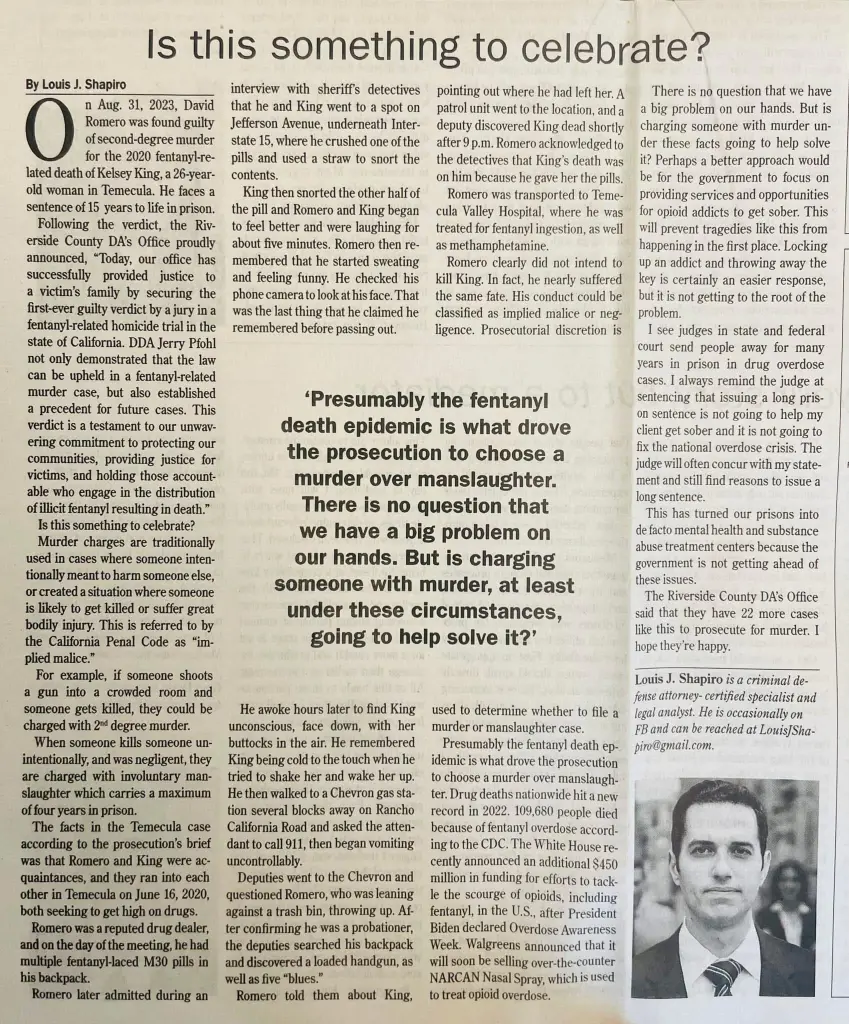
Responding to the Riverside County District Attorney’s announcement of what it called California’s first jury verdict of murder in a fentanyl-related death, Lou Shapiro asks whether the outcome is something to celebrate.
He walks through the facts presented at trial and the line between implied-malice murder and involuntary manslaughter, arguing that the defendant did not intend to kill and nearly died himself. While acknowledging the scale of the fentanyl crisis, he argues that charging these cases as murder will not solve it, that long sentences turn prisons into de facto treatment centers, and that investing in services to help people with opioid addiction get sober would do more to prevent future deaths.
Published in the Los Angeles Daily Journal.
Full text of the article
On Aug. 31, 2023, David Romero was found guilty of second-degree murder for the 2020 fentanyl-related death of Kelsey King, a 26-year-old woman in Temecula. He faces a sentence of 15 years to life in prison.
Following the verdict, the Riverside County DA’s Office proudly announced, “Today, our office has successfully provided justice to a victim’s family by securing the first-ever guilty verdict by a jury in a fentanyl-related homicide trial in the state of California. DDA Jerry Pfohl not only demonstrated that the law can be upheld in a fentanyl-related murder case, but also established a precedent for future cases. This verdict is a testament to our unwavering commitment to protecting our communities, providing justice for victims, and holding those accountable who engage in the distribution of illicit fentanyl resulting in death.”
Is this something to celebrate?
Murder charges are traditionally used in cases where someone intentionally meant to harm someone else, or created a situation where someone is likely to get killed or suffer great bodily injury. This is referred to by the California Penal Code as “implied malice.”
For example, if someone shoots a gun into a crowded room and someone gets killed, they could be charged with 2nd degree murder.
When someone kills someone unintentionally, and was negligent, they are charged with involuntary manslaughter which carries a maximum of four years in prison.
The facts in the Temecula case according to the prosecution’s brief was that Romero and King were acquaintances, and they ran into each other in Temecula on June 16, 2020, both seeking to get high on drugs.
Romero was a reputed drug dealer, and on the day of the meeting, he had multiple fentanyl-laced M30 pills in his backpack.
Romero later admitted during an interview with sheriff’s detectives that he and King went to a spot on Jefferson Avenue, underneath Interstate 15, where he crushed one of the pills and used a straw to snort the contents.
King then snorted the other half of the pill and Romero and King began to feel better and were laughing for about five minutes. Romero then remembered that he started sweating and feeling funny. He checked his phone camera to look at his face. That was the last thing that he claimed he remembered before passing out.
He awoke hours later to find King unconscious, face down, with her buttocks in the air. He remembered King being cold to the touch when he tried to shake her and wake her up. He then walked to a Chevron gas station several blocks away on Rancho California Road and asked the attendant to call 911, then began vomiting uncontrollably.
Deputies went to the Chevron and questioned Romero, who was leaning against a trash bin, throwing up. After confirming he was a probationer, the deputies searched his backpack and discovered a loaded handgun, as well as five “blues.”
Romero told them about King, pointing out where he had left her. A patrol unit went to the location, and a deputy discovered King dead shortly after 9 p.m. Romero acknowledged to the detectives that King’s death was on him because he gave her the pills.
Romero was transported to Temecula Valley Hospital, where he was treated for fentanyl ingestion, as well as methamphetamine.
Romero clearly did not intend to kill King. In fact, he nearly suffered the same fate. His conduct could be classified as implied malice or negligence. Prosecutorial discretion is used to determine whether to file a murder or manslaughter case.
Presumably the fentanyl death epidemic is what drove the prosecution to choose a murder over manslaughter. Drug deaths nationwide hit a new record in 2022. 109,680 people died because of fentanyl overdose according to the CDC. The White House recently announced an additional $450 million in funding for efforts to tackle the scourge of opioids, including fentanyl, in the U.S., after President Biden declared Overdose Awareness Week. Walgreens announced that it will soon be selling over-the-counter NARCAN Nasal Spray, which is used to treat opioid overdose.
There is no question that we have a big problem on our hands. But is charging someone with murder under these facts going to help solve it? Perhaps a better approach would be for the government to focus on providing services and opportunities for opioid addicts to get sober. This will prevent tragedies like this from happening in the first place. Locking up an addict and throwing away the key is certainly an easier response, but it is not getting to the root of the problem.
I see judges in state and federal court send people away for many years in prison in drug overdose cases. I always remind the judge at sentencing that issuing a long prison sentence is not going to help my client get sober and it is not going to fix the national overdose crisis. The judge will often concur with my statement and still find reasons to issue a long sentence.
This has turned our prisons into de facto mental health and substance abuse treatment centers because the government is not getting ahead of these issues.
The Riverside County DA’s Office said that they have 22 more cases like this to prosecute for murder. I hope they’re happy.
Louis J. Shapiro is a criminal defense attorney-certified specialist and legal analyst. He is occasionally on FB and can be reached at LouisJShapiro@gmail.com.