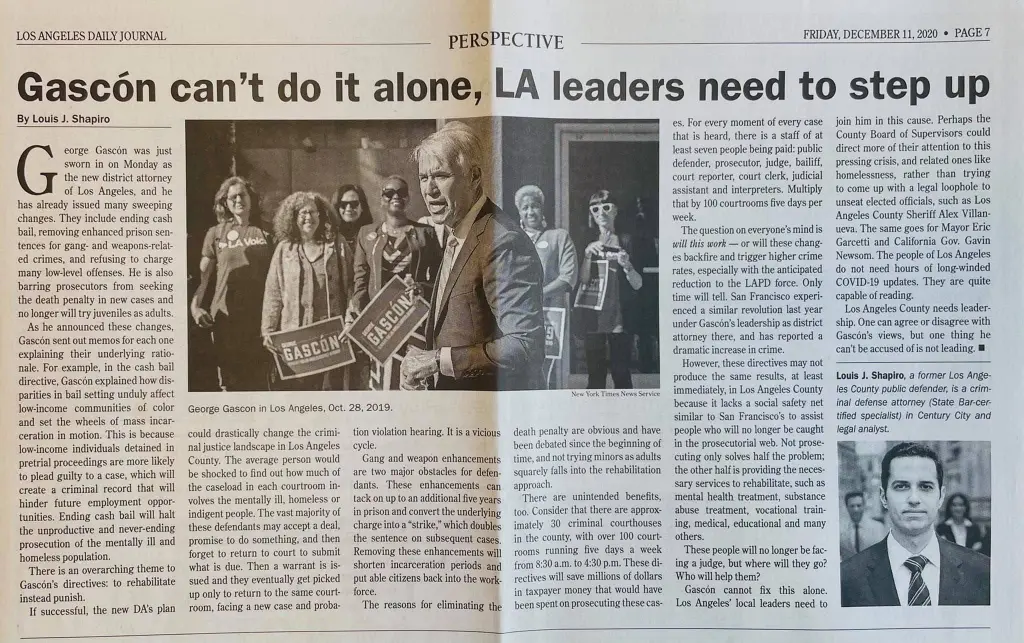
Days after George Gascón was sworn in as Los Angeles County District Attorney, Lou Shapiro, a former county public defender, reviews his first directives, including ending cash bail, dropping many sentencing enhancements, no longer seeking the death penalty in new cases, and no longer trying juveniles as adults.
He argues that declining to prosecute only solves half the problem: unlike San Francisco, Los Angeles County lacks the safety net of mental health and substance abuse treatment, vocational training and other services needed to support people diverted from prosecution. He calls on county and state leaders to step up alongside the new district attorney, and concludes that whatever one thinks of Gascón’s views, he is at least leading.
Published in the Los Angeles Daily Journal, December 11, 2020.
Full text of the article
George Gascón was just sworn in on Monday as the new district attorney of Los Angeles, and he has already issued many sweeping changes. They include ending cash bail, removing enhanced prison sentences for gang- and weapons-related crimes, and refusing to charge many low-level offenses. He is also barring prosecutors from seeking the death penalty in new cases and no longer will try juveniles as adults.
As he announced these changes, Gascón sent out memos for each one explaining their underlying rationale. For example, in the cash bail directive, Gascón explained how disparities in bail setting unduly affect low-income communities of color and set the wheels of mass incarceration in motion. This is because low-income individuals detained in pretrial proceedings are more likely to plead guilty to a case, which will create a criminal record that will hinder future employment opportunities. Ending cash bail will halt the unproductive and never-ending prosecution of the mentally ill and homeless population.
There is an overarching theme to Gascón’s directives: to rehabilitate instead punish.
If successful, the new DA’s plan could drastically change the criminal justice landscape in Los Angeles County. The average person would be shocked to find out how much of the caseload in each courtroom involves the mentally ill, homeless or indigent people. The vast majority of these defendants may accept a deal, promise to do something, and then forget to return to court to submit what is due. Then a warrant is issued and they eventually get picked up only to return to the same courtroom, facing a new case and probation violation hearing. It is a vicious cycle.
Gang and weapon enhancements are two major obstacles for defendants. These enhancements can tack on up to an additional five years in prison and convert the underlying charge into a “strike,” which doubles the sentence on subsequent cases. Removing these enhancements will shorten incarceration periods and put able citizens back into the workforce.
The reasons for eliminating the death penalty are obvious and have been debated since the beginning of time, and not trying minors as adults squarely falls into the rehabilitation approach.
There are unintended benefits, too. Consider that there are approximately 30 criminal courthouses in the county, with over 100 courtrooms running five days a week from 8:30 a.m. to 4:30 p.m. These directives will save millions of dollars in taxpayer money that would have been spent on prosecuting these cases. For every moment of every case that is heard, there is a staff of at least seven people being paid: public defender, prosecutor, judge, bailiff, court reporter, court clerk, judicial assistant and interpreters. Multiply that by 100 courtrooms five days per week.
The question on everyone’s mind is will this work — or will these changes backfire and trigger higher crime rates, especially with the anticipated reduction to the LAPD force. Only time will tell. San Francisco experienced a similar revolution last year under Gascón’s leadership as district attorney there, and has reported a dramatic increase in crime.
However, these directives may not produce the same results, at least immediately, in Los Angeles County because it lacks a social safety net similar to San Francisco’s to assist people who will no longer be caught in the prosecutorial web. Not prosecuting only solves half the problem; the other half is providing the necessary services to rehabilitate, such as mental health treatment, substance abuse treatment, vocational training, medical, educational and many others.
These people will no longer be facing a judge, but where will they go? Who will help them?
Gascón cannot fix this alone. Los Angeles’ local leaders need to join him in this cause. Perhaps the County Board of Supervisors could direct more of their attention to this pressing crisis, and related ones like homelessness, rather than trying to come up with a legal loophole to unseat elected officials, such as Los Angeles County Sheriff Alex Villanueva. The same goes for Mayor Eric Garcetti and California Gov. Gavin Newsom. The people of Los Angeles do not need hours of long-winded COVID-19 updates. They are quite capable of reading.
Los Angeles County needs leadership. One can agree or disagree with Gascón’s views, but one thing he can’t be accused of is not leading.
Louis J. Shapiro, a former Los Angeles County public defender, is a criminal defense attorney (State Bar-certified specialist) in Century City and legal analyst.